

Key Takeaways:
- An Erogenous Zone: The A-spot refers to a deep area near the anterior fornix, close to the cervix, rather than a universally established anatomical “point.”
- Different From the G-Spot: Both are associated with the front vaginal wall, but the A-spot is generally described as being deeper and closer to the cervix.
- Responses Vary: Some women report increased lubrication, arousal, or pleasure, while others may notice little or no particular sensation.
- Exploration Is Optional: Understanding the A-spot can help you learn about your anatomy, but finding it is not necessary for sexual wellbeing or satisfying sexual experiences.
What Is the A-spot?
The A-spot refers to a sensitive area located deep within the vagina, close to the cervix. For some people, stimulating this region may contribute to pleasurable sensations and increased vaginal lubrication.
The area was described by researcher Chua Chee Ann in research published in 1997. Participants in the study reported greater arousal and lubrication after approximately 10–15 minutes of stimulation.
Chua Chee Ann proposed that stimulation of this area could potentially be relevant to certain sexual difficulties, including vaginal dryness and discomfort during intercourse.
Where Is the A-spot Located?
The A-spot is generally located along the upper front (anterior) wall of the vaginal canal, deeper than the area commonly associated with the G-spot and closer to the cervix.
If you imagine the front vaginal wall as the side facing toward your belly button, the area commonly called the G-spot is generally described farther toward the entrance, while the A-spot is described deeper along the same general direction, near the upper vaginal fornix.
How Deep Is the A-spot?
This area is generally deeper within the vaginal canal, typically around 4 to 6 inches (10 to 15 cm) from the vaginal opening. Its exact location can vary from person to person due to natural anatomical differences. For this reason, there is no single depth or precise point that applies to everyone.
A-spot vs. G-Spot: What’s the Difference?
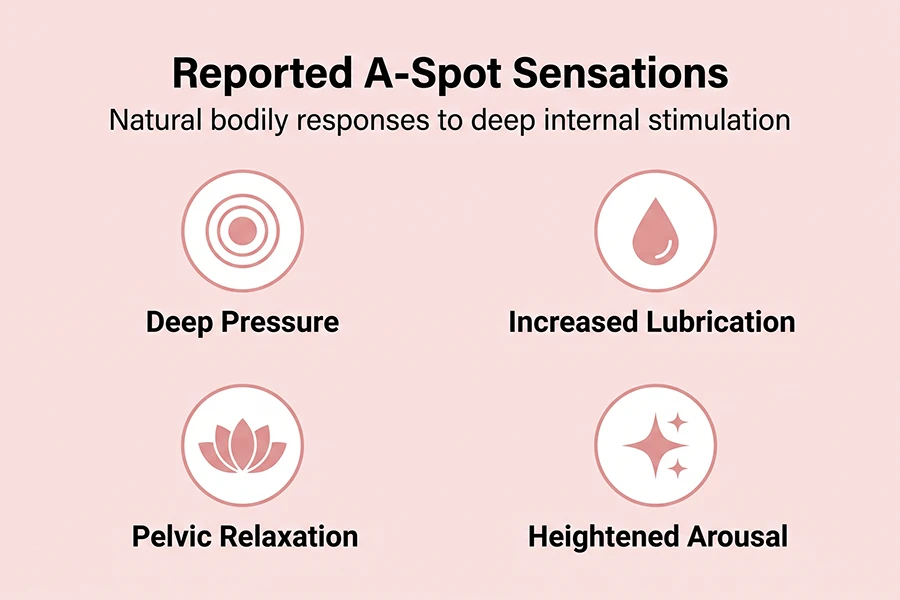
The A-spot and G-spot are both commonly discussed in relation to the anterior vaginal wall, but they are described as different regions. This table highlights the key differences between these two areas in terms of their location, depth, anatomical status, and commonly reported sensations.
| Feature | G-Spot | A-spot |
| Location | Generally described along the anterior vaginal wall closer to the vaginal entrance | Described deeper along the anterior wall, near the upper vaginal fornix and cervix |
| Depth | Relatively more accessible | Deeper internal location |
| Anatomical status | Its existence as a distinct anatomical structure remains debated | Its existence as a distinct anatomical structure is also not firmly established |
| Reported sensations | Some women report increased sensitivity or pleasure | Some women report deeper pressure, increased lubrication, or pleasurable sensations |
Is the A-spot Actually Real?
Yes. This area is considered a real and responsive pleasure area by many sex educators and experts, though scientific research on its exact location and function is still limited.
From My Consulting Room:
A common concern I hear in my clinic is the feeling that something must be “missing” when a woman does not experience pleasure from deep internal stimulation. I would encourage those clients to shift the focus away from “hunting for A-spot” and toward comfortable breathing, relaxation, and paying attention to what her own body actually responds to. The goal is exploration without pressure, not proving that a particular anatomical point has to work.
What Does A-spot Stimulation Feel Like?
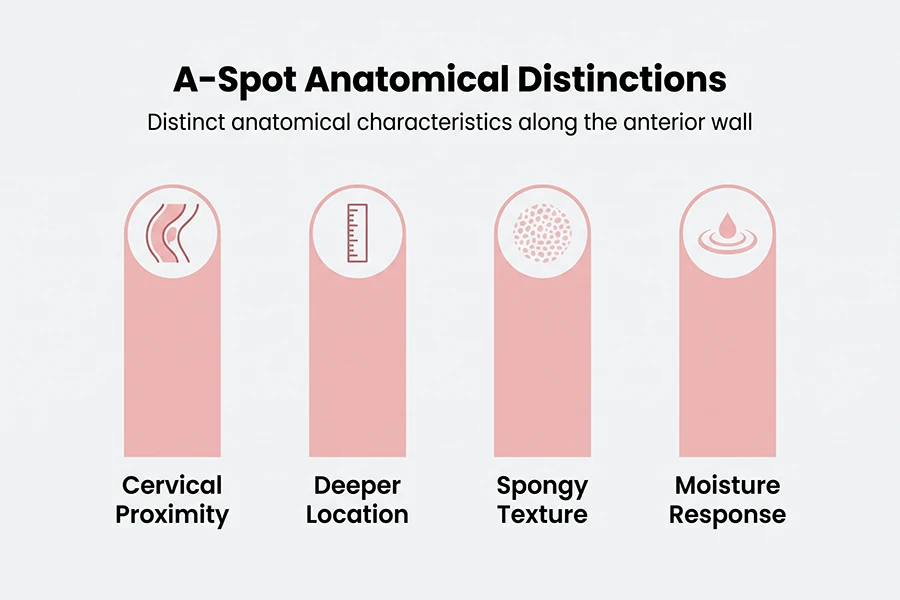
Unlike the G-spot, the A-spot does not usually feel noticeably different from the surrounding vaginal tissue. Its texture can vary naturally from person to person, and some people may notice a softer or slightly spongier sensation when gentle pressure is applied.
Some reported experiences include:
- Deep Pressure: A sense of pressure or fullness deeper inside the pelvis.
- Increased Lubrication: Some women report greater vaginal moisture during stimulation and arousal.
- Pelvic Relaxation: For some, comfortable stimulation may be accompanied by a feeling of reduced pelvic tension.
- Heightened Arousal: Some women describe an increase in overall arousal or pleasurable sensation.
It is equally important to remember that some women may feel very little at the A-spot, while others may find deep pressure uncomfortable. Contact near the cervix can also be uncomfortable for some people, particularly when pressure is too strong. Neither response is a sign that something is wrong. Your anatomy and nervous system are individual, and sexual wellbeing does not depend on responding to one particular area.
How to Find the A-spot?
If you choose to explore this area, I recommend keeping the experience focused on comfort, curiosity, and your own response rather than treating the A-spot as something you must find.
- Start with the G-spot: Gently insert a clean finger about 1–2 inches and curve it toward your belly button to locate the general area of the G-spot.
- Move deeper: Slowly move your finger another 2 inches deeper, toward the cervix, where the A-spot is thought to be located.
- Use gentle movements: Try slow, curved or side-to-side movements rather than repetitive in-and-out motion.
- Focus on your response: You may notice increased sensitivity, pressure, pleasure, or lubrication, or nothing at all. All of these responses are normal.
- Don’t force it: If reaching the area feels uncomfortable or painful, stop. Individual anatomy and sensitivity vary.

How Can the A-spot Be Stimulated?
Because the A-spot is described as a deeper area near the upper vaginal fornix, some people may find it difficult to reach comfortably with their fingers. If you choose to use an internal wellness device, a smooth, curved design with an appropriate length may make exploration easier.
For intimate wellness products, I recommend paying attention to practical features such as body-safe, non-porous materials that are easy to clean and a waterproof design when appropriate. The goal is comfortable, controlled exploration rather than applying strong pressure or assuming that deeper stimulation is necessarily better.
If you are considering a curved internal vibrator, choose one that allows you to control the intensity and position comfortably. You can explore suitable options through Selove’s collection of curved internal vibrators.
Read More: External vs Internal Vibrators: What You Must Know Before Buying
Can A-spot Stimulation Cause an Orgasm?
A-spot stimulation generally involves deeper vaginal penetration. However, penetration alone does not lead to orgasm for most women; research suggests that fewer than 20% reach orgasm through penetration alone.
Some experts suggest that people who experience orgasm with deep vaginal stimulation may be responding to sensations from the area associated with the A-spot. However, there is not enough evidence to classify these experiences as a distinct type of orgasm or to say that A-spot orgasms are necessarily more intense or longer-lasting than other orgasms.
If you have not experienced orgasm through vaginal penetration, there is no reason to assume that you are missing a specific “magic” spot. Sexual response varies widely, and pleasure can involve several types of stimulation.
Do You Need to Find Your A-spot?
The short answer is no. Sexual wellbeing does not depend on finding a particular anatomical spot, and there is no reason to turn your body into a map of locations you are expected to unlock.
If exploring the A-spot feels comfortable and interesting to you, it can be one way to learn more about your body. If you do not notice a particular sensation, prefer external stimulation, or simply have no interest in finding it, that is completely normal too. Your capacity for pleasure does not depend on reaching a specific anatomical benchmark.
Final Thoughts
Understanding your sexual wellbeing is an ongoing journey of self-discovery, body acceptance, and gentle care. Learning about anatomy, including the A-spot, can help you make informed choices without feeling pressured to find or respond to one specific area. Stay curious, listen to your body, and always prioritize comfort over expectations.
Feel free to share your questions or experiences in the comments and help create more open conversations about women’s pelvic health and sexual wellbeing.
References: healthline medicalnewstoday
Can A-spot stimulation cause pain?
Yes. Deep pressure may feel uncomfortable, especially when the body is tense or pressure is applied near the cervix. Stop if you experience sharp or persistent pain.
Does the A-spot become easier to reach during arousal?
Yes. Arousal can temporarily change the vaginal canal and surrounding structures, which may make deeper exploration more comfortable for some people. However, there is no technique or depth that works for everyone.
Is it normal not to feel anything when the A-spot is stimulated?
Yes. Everyone has different anatomy and sexual responses, and pleasure does not depend on sensitivity to the A-spot or any other specific internal area.